
What is the purpose of the book?
This is a note for parents, teachers or language therapists about the book and its contents. The Mind the Book series attempts to present real stories to children with content that is both appealing and educational.
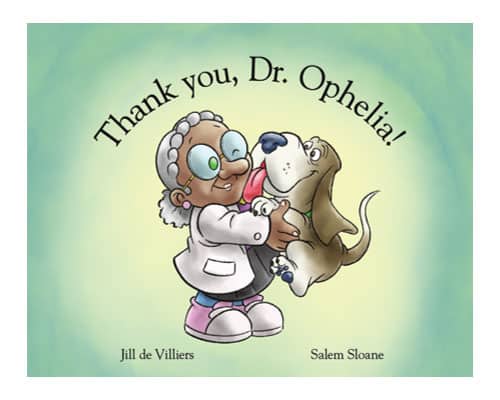
But there is another factor in the design of the books, which is to use examples of complex grammar that the child needs to express the meanings. In Thank you Dr. Ophelia, certain grammatical forms repeat throughout the story. These are called “sentence complements,” and they describe what somebody thought or said, such as when Dr. Ophelia says to the tortoise, “You thought you had a lump on your back.” This is a very important sentence type because it describes mistakes, or lies, or “false beliefs,” which preschool children struggle with. We know that increased exposure to such sentences gives children the tools they need for this special kind of reasoning, namely, working out that other people can have different ideas or beliefs than their own, and that some beliefs might be false. This book packs the sentence types in, repetitively, but without being a drill. In ordinary life, we know that caregivers produce such sentences only a couple of times a week, which is a very low frequency for children to catch on to their special properties. By reading the book, children hear many more such examples in contexts that enhance their understanding.
Teachers and Parents
To make the most of reading the book, we suggest that the reader pause and ask questions to the child, that is, make the reading a dialogue. We have provided a set of questions to guide your discussion over four weeks of reading. On the first reading, we suggest you concentrate on the facts, such as “What is the dog called?” On later readings, we suggest asking, e.g. “What does the tortoise say he has on his back?” Don’t be surprised when the child says, “A shell!” When the child answers with something unsatisfactory, say, “Let’s check that again.” Then, reread the section, and say, “Tell me what he SAID he had on his back?” We suggest you provide the right answer after two tries, rather than persisting. When the child can answer these questions successfully, they are poised to succeed on tasks probing “theory of mind,” a breakthrough understanding about other people’s mental states that normally happens around 4 or 5 years.
We created a document to help you ask questions during reading:
Here are instructions for using the Sticky Notes:
- Print the document.
- Put sticky notes on the template and reprint the document.
- Place the sticky notes for week 1 in the correct place in the book to guide your questioning while reading the book.
- Replace the sticky notes at the end of each week for the next week’s reading.
Classroom
In a classroom setting, teachers may be able to expand the reading into activities that will help further understanding. Here are some ideas:
- Have the children consider other animals that have “weird” properties that they may come to Dr. Ophelia about. For example, why do spiders have so many legs? Why do anteaters have such a long nose? They could look through books to find them.
- Have them find out what that property allows the animal to do.
- Put on a play! The book lends itself to being acted out because so much of it is dialogue. Pairs of students could play e.g., Dr. Ophelia and one of the animals, and act out what they say. It doesn’t have to be a perfect script! In fact, it would be revealing to see how the children took it in and interpreted it, and provide more opportunities for gentle teaching by modeling from one another.
- Have children think about all the ways dogs vary. How have people changed the variety of dogs for different skills and properties? Talk about dogs they may have met or own.
- Start a discussion about why the dog Rumpole in the book spread his worry across the animals. Why did he feel bad about himself? What made him tell the animals they had problems too?
