
Latina/o/e/x 1 Language in the United States
People of Latin American origin are among the fastest growing minoritized groups in the United States. Current projections indicate that the Latinx community will account for roughly one quarter of the U.S. population by 2045 (census.gov 2018). The popular image of these communities often focuses on traditional Mexican American communities in the Southwest and Caribbean communities in the Northeast. However, significant Latinx communities now exist throughout the United States, with recent growth in the Southeastern United States and include groups with national origins throughout Central America, South America, and the Caribbean. It is clear that the Latinx community is in fact a set of communities, with substantial and significant linguistic and cultural variation. However, as Ed Morales (2002) argues in his book Living in Spanglish, there is a unifying sense of hybridity in the Latinx experience. For him, the essence of the Latinx experience is found in speaking Spanglish, a blend of Spanish and English that “expresses not ambivalence, but a new region of discourse that has the possibility of redefining.” And, as these rapidly growing, diverse, and complex communities make up an ever-increasing percentage of students and parents, it is critically important for educators to be aware of both the linguistic and sociological nature of these communities.
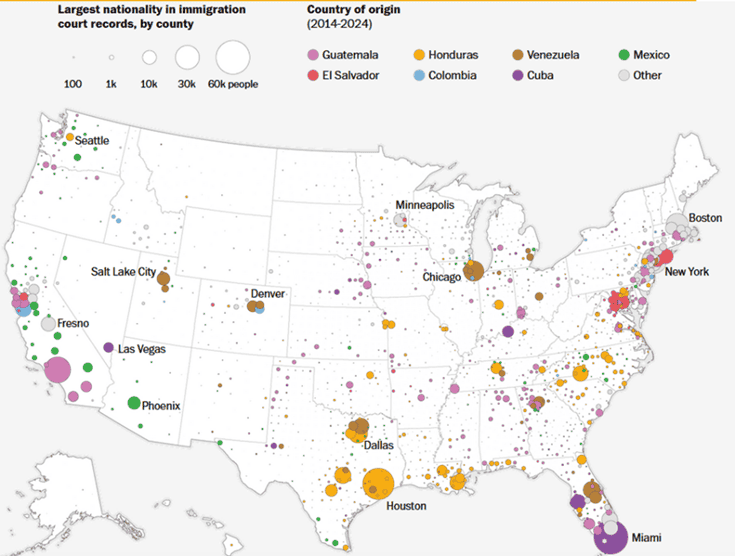
Blanco Ramos, A., Rich, S., Miroff, N., & Sacchetti, M. (2024, June 26). 4.1 million migrants: Where they’re from, where they live in the U.S. [Interactive]. The Washington Post. https://www.washingtonpost.com/immigration/interactive/2024/us-immigration-where-migrants-live/
A wide range of terms related to the language used by U.S. Latinx communities have appeared in the literature, many of which are aligned with national origins, such as Chicano English, Mexican American English, Puerto Rican English, and Cuban English or with U.S. locales like New York Latinx English (Slomanson & Newman 2004; Newman 2010) Miami English (Carter et al. 2020) or New Orleans Latinx English (Lewis 2019, 2022a, 2022b) and/or draw clear lines between research focused on English and research focused on Spanish. In this text I align with Carter et al’s (2023) argument for the use of Latinx Language (LL) based on recognizing that the distinction between English and Spanish often observed in the literature is imposed based on academic presumptions, while actual language use in Latinx communities is developing “in ways that resist the binary of ‘Spanish’ versus ‘English’” (52). For this reason, I will use the term Latinx Language, abbreviated LL, to refer to the entire continuum of linguistic practices observed in U.S. Latinx communities.
Features of LL
Early research on LL tended to be focused on identifying the constellation of linguistic features making up the variety, although there was an early recognition that LL was not a single variety, but a constellation of varieties shaped by different patterns of contact between American English, AAL, and different national varieties of Spanish. For example, Wolfram (1973) presented a description of phonological and morphosyntactic features found in the speech of second-generation Puerto Rican males from Harlem. In addition to identifying a set of linguistic markers, he was among several scholars who have noted that LL is often influenced by AAL (Dunstan 2010; Carter 2013). Poplack (1978, 1980), Urciuoli (1984, 1996), and Zentella (1981a, 1981b, 1997) also provided early explorations of LL in the context of the New York City Puerto Rican community. Other research on LL (Peñalosa, 1980; Santa Ana, 1991; Fought, 1997, 2003) was similarly focused on describing the inventory of stable linguistic markers of Chicanx English (CE) in the American Southwest. More recently, scholars in New York City have examined the formation of context specific pan-Latinx varieties (Newman 2003, 2010; Slomanson & Newman 2004). While research has identified variation in the linguistic features associated with LL depending on the national heritage of the speaker community and the nature of the local setting, there are a core of phonetic features which have emerged across the literature. These include vocalic features such as more backed realizations of the BOOT vowel, lowered and backed realizations of the BAT vowel, consonant features such as the lack of a dark /l/ sound, /th/ stopping, and a greater tendency towards syllable timed prosody.
LL, Context, & Identity
Subsequent work has expounded on the role of context and identity in LL use. For example, Norma Mendoza-Denton (1997, 2008) described how language performance among Chicana youth gang members was shaped by personal identity. Carter (2014) discusses how national discourses of threat (Chavez, 2008) are rearticulated locally in ways that shape the linguistic practices of high school students in North Carolina. Lewis (2022a, 2022b) demonstrates that language use in a Latinx community in New Orleans in terms of the production of the BAT vowel, prosodic timing, and language choice is shaped by both localized threat narratives and by individual positionalities within local Latinx social networks (Milroy 1987; Dodsworth and Benton 2020). Tseng (2015) focuses on the construction of a Latinx identity, demonstrating that Latinx speakers in Washington, D. C. manipulate the production of the BAT vowel in the process of identity negotiation. These are but a handful of examples demonstrating how LL can vary from community to community, individual to individual within a community, and even context to context within a single individual. What the work described in this paragraph illustrates is that, far from being a single easily delineated set of linguistic features, LL is in fact a complex, evolving, flexible set of linguistic features that can be drawn on by speakers in the negotiation and performance of a Latinx identity (Bucholtz and Hall 2005), perhaps best understood not as an ethnolect but as an ethnolinguistic repertoire (Benor 2008, 2010).
LL, Language Choice, & Hybridity
Another important body of research that addresses LL as a marker of identity explores the blending or merging of English and Spanish in the speech of U.S. Latinxs. Code-switching research has accounted for a major portion of the research into language use in Latinx communities since at least the early 1980s, as seen in Shana Poplack’s (1980) seminal article in the journal Linguistics titled “Sometimes I’ll start a sentence in Spanish y termino en español.” This early research was often concerned with demonstrating that code-switching is a feature of fluent bilingualism and not of imperfect acquisition and with identifying linguistic constraints on code-switching behavior (Huerta 1978; Durán 1981; Zentella 1981a, 1981b; Woolford 1983; Lipski 1985). More recently, scholars have applied the term translanguaging (Williams 1994) to account for the ways in which bilingual language use is less a process of switching between discrete, bounded linguistic systems and more a creative, synthesizing act of language performance (García 2009; García & Wei 2015; Wei 2018). These bilingual (and multidialectal) language practices of Latinxs are a natural outgrowth of Latinxs multi-ethnic, multi=cultural, and multi-lingual identities.
Closely related is research on language attrition and language use in public space. Bonnie Urciuoli (1996) and Ana Celia Zentella’s (1981a, 1981b, 1997) work on code-switching and language choice among Puerto Ricans in New York City, Jane Hill’s work on Mock Spanish, and Otto Santa Ana (2002)’s work on metaphors of latinidad all explore the construction of public space, observing that both Latinxs choice of language and the choice of words to describe Latinxs do not take place in a vacuum, but is instead heavily influenced by attitudes towards language in the larger White community. Urciuolli, Hill, and Zentella’s work all converge around the important observation that language is a key component in the process of racialization that articulates Latinxs in the U.S. as a racialized other. Language then becomes a key component in the monitoring and sanctioning of Latinx identity performance in white public space (Page and
Hill 1994).
LL in U.S. Educational Contexts
One of the critical sites of the public racialization of Latinxs are schools, and there is therefore an important body of scholarship related to LL users explores the intersections of language and identity within the U.S. educational system. While the National Council of Teachers of English has long affirmed that students have the right to use the languages and dialects in which they are most comfortable (1973), the U.S. educational system has often demanded students acquire and use a “standardized” 2 variety of English in the classroom. This linguistic gatekeeping has adversely impacted access to education for migrant children as well as for the children and grandchildren of Latin American migrants. By the turn of the 21st century, there was a growing consensus among scholars that subtractive approaches aimed at replacing Spanish with English were problematic and that an additive approach aimed at adding proficiency in a “standardized English” to students’ existing linguistic proficiencies (Cummins 2000). More recent work on raciolinguistic ideologies (Flores & Rosa 2015; Alim et al. 2016; Rosa & Flores 2017; Rosa 2019) and translanguaging (García 2009; García & Wei 2015; Wei 2018) has affirmed that additive approaches are preferred to subtractive approaches while challenging scholars and educators to consider the ways these approaches can also be fraught with problematic ideologies related to what types of language use are considered “appropriate” for academic settings and the ways that educators’ evaluation of students’ language use can be driven by the perception of these students through the lens of the white listening subject (Rosa & Flores 2015).
Conclusion
As described here, LL is a complex, highly variable ethnolinguistic repertoire used by Latinxs in the United States in the performance and negotiation of their individual ethnic identities. When describing LL, it is important to remember that individual linguistic performance can vary along a wide range of social, cultural, and contextual factors. However, research has three important aspects of LL that are widely accepted. First, there is a fairly stable set of sociolinguistic variables that can be used in the linguistic performance of a Latinx identity, several of which were described above. Second, LL, similar to the culture it indexes, is defined by hybridity, blending various dialects of English and Spanish in often creative and unique ways. Third, LL, and specifically the language of Latinx children, has often been engaged in the reflection and reproduction of problematic social hierarchies in the American educational setting. As the United States becomes increasingly diverse and Latinx communities become an increasingly salient part of our school systems, educators would do well to look for ways to incorporate these insights into the classroom in ways that make our schools the welcoming, transformative spaces they have the potential to be.
Author: Thomas D. Lewis, Ph.D.
1 1 I use the term “Latinx” in this text as a gender-neutral term to refer to people of Latin American heritage currently residing in the United States. I recognize that the term Latinx is itself controversial. Proponents argue that the term is a more inclusive label for the community. Opponents argue that the term is primarily used in academic circles and difficult to pronounce in Spanish. In many ways, this debate itself seems largely academic, as a 2021 Gallup poll shows that adult Hispanic Americans, when asked to choose between, ‘Hispanic,’ ‘Latino,’ ‘Latinx,’ ‘Another Term,’ or ‘Does Not Matter,’ overwhelmingly choose ‘Does Not Matter.’
2 The quotes here acknowledge the problematic nature of the idea of a standard variety of US English. While further discussion is beyond the scope of this article, see Barrett et al. (2022) for an in-depth exploration of the problematic nature of this term.
References
Alim, H. Samy, John R. Rickford, and Aretha F. Ball. 2016. Raciolinguistics: How language shapes our ideas about race. Oxford University Press.
Barrett, Rusty, Jennifer Cramer, and Kevin McGowan. 2022. English with an Accent. 3rd Ed. Routledge,
Benor, Sarah B. (2008). “Towards a New Understanding of Jewish Language in the Twenty-First Century.” Religion Compass 2, no. 6: 1062–1080. http://doi.org/10.1111/j.1749-8171.2008.00108.x.
Benor, Sarah B. 2010. “Ethnolinguistic Repertoire: Shifting the Analytic Focus in Language and Ethnicity.” Journal of Sociolinguistics 14, no. 2: 159–183.
Bucholtz, Mary and Kira Hall. 2005. “Identity and Interaction: A Sociocultural Linguistic Approach.” Discourse Studies 7, no. 4–5:585–614.
Carter, Phillip M. 2013. “Shared Spaces, Shared Structures: Latino Social Formation and African American English in the U. S. South.” Journal of Sociolinguistics 17, no. 1: 66-92. https://doi.org/10.1111/josl.12015.
Carter, Phillip M. 2014. “National Narratives, Institutional Ideologies, and Local Talk: The Discursive Production of Spanish in a “New” US Latino Community.” Language in Society 43, no. 02: 209–240. http://doi.org/10.1017/S0047404514000049.
Carter, Phillip M., Lydda López Valdez, and Nandi Sims. 2020. “New Dialect Formation Through Language Contact: Vocalic and Prosodic Developments in Miami English.” American Speech 95, no. 2: 119-148.
Carter, Phillip M., Salvatore Callesano, S. and Lydda López Valdez. 2023. “Language in U. S. Latinx Communities.” In Needed Research in North American Dialects, edited by Erica J. Benson and Robert Bayley. Duke University Press.
Dodsworth, Robin, & Richard Benton. 2020. Language Variation and Change in Social Networks: A Bipartite Approach. Routledge.
Dunstan, Stephany Brett. 2010. “Identities in Transition: The Use of AAVE Grammatical Features by Hispanic Adolescents in Two North Carolina Communities.” American Speech 85, no. 2: 185-204.
Durán, Richard P. 1981. Latino Language and Communicative Behavior. Praeger.
Flores, Nelson. 2016. “A Tale of Two Visions: Hegemonic Whiteness and Bilingual Education.” Educational Policy 30, no. 1:13–38.
Flores, Nelson and Jonathan Rosa. 2015. “Undoing Appropriateness: Raciolinguistic Ideologies and Language Diversity in Education.” Harvard Educational Review 85, no. 2: 149-171.
Fought, Carmen. 1997. “The English and Spanish of Young Adult Chicanos.” Ph.D. Diss. University of Pennsylvania.
Fought, Carmen. 2003. Chicano English in Context. Palgrave MacMillan.
García, Ofelia. 2009. Bilingual Education in the 21st Century. Wiley-Blackwell.
García, Ofelia. and Li Wei. 2015. “Translanguaging, Bilingualism, and Bilingual Education.” In The Handbook of Bilingual and Multilingual Education, edited by Wayne E. Wright, Sovicheth Boun, and Ofelia García. Wiley Blackwell.
Hill, Jane H. 1998. “Language, Race, and White Public Space.” American Anthropologist 100, no. 3: 680-689.
Hill, Jane H. 2008. The Everyday Language of White Racism. John Wiley & Sons.
Huerta, Ana Graciela. 1978. “Code Switching Among Spanish-English Bilinguals: A Sociolinguistic Perspective.” Ph.D. Diss. University of Texas, Austin.
Lewis, Tom. 2019. “Before the Storm, There Wasn’t Much of a Thought, When Katrina Happened, That Changed Everything: Social Network Geometry, Discourses of Threat, and English Usage Among Latinxs in Post-Katrina New Orleans.” Ph.D. Dissertation. Tulane University.
Lewis, Tom. 2022a. “Linguistic White Privilege: Threat Narratives and Raciolinguistic Ideologies in Post Katrina New Orleans.” Journal of Language and Discrimination 6, no. 2: 241-260. https://doi.org/10.1558/jld.21373.
Lewis, Tom. 2022b. “Social Network Geometry, Linguistic Ideologies, and Identity Negotiation among Latinx English speakers in New Orleans.” Journal of Sociolinguistics 26, no. 5: 624-647. https://doi.org/10.1111/josl.12596.
Lipski, John M. 1985. Linguistic Aspects of Spanish-English Language Switching. Arizona State University, Center for Latin American Studies.
Mendoza-Denton, Norma 1997. “Chicana/Mexicana Identity of Linguistic Variation: An Ethnographic and Sociolinguistic Study of Gang Affiliation in an Urban High School.” Ph.D. Diss. Stanford University.
Mendoza-Denton, Norma. 2008. Homegirls: Language and Cultural Practice among Latina Youth Gangs. Blackwell.
Milroy, Lesley. 1987. Language and Social Networks. Wiley-Blackwell.
Newman, Michael. 2003. “Youth Cultural Identity and Dialect Formation in New York Latino English.” Paper presented at Linguistic Society of America, Atlanta, GA.
Newman, Michael. 2010. “Focusing, Implicational Scaling, and the Dialect Status of New York Latino English.” Journal of Sociolinguistics 14, no. 2: 207–239. http://doi.org/10.1111/j.1467-9841.2010.00441.x.
Newman, Michael and Peter Slomanson. 2003. “Interactions Between Youth Cultural Identity and National Heritage in New York Latino English(es).” Paper presented at International Linguistics Association Annual Meeting. New York.
Page, H. E., & Thomas, B. 1994. “White Public Space and the Construction of White Privilege in U. S. Healthcare: Fresh Concepts and a New Model of Analysis.” Medical Anthropology Quarterly 8: 109–116.
Peñalosa, Fernando. 1980. Chicano Sociolinguistics: A Brief Introduction. Newbury House.
Penfield, Joyce and Jacob L. Ornstein-Galicia. 1985. Chicano English: An Ethnic Contact Dialect. John Benjamins.
Poplack, Shana. 1980. “Sometimes I’ll Start a Sentence in Spanish y Termino en Español: Toward a Typology of Code-switching.” Linguistics 18: 581-618.
Rosa, Jonathan. 2016. “From Mock Spanish to Inverted Spanglish: Language Ideologies and the Racialization of Mexican and Puerto Rican Youth in the United States.” In Raciolinguistics: How Language Shapes Our Ideas About Race, edited by H. Samy Alim, John R. Rickford, and Aretha F. Ball. Oxford: Oxford University Press.
Rosa, Jonathan. 2019. Looking Like a Language, Sounding Like a Race: Raciolinguistic Ideologies and the Learning of Latinidad. Oxford University Press.
Rosa, Jonathan, and Nelson Flores. 2017. “Unsettling Race and Language: Toward a Raciolinguistic Perspective.” Language in Society 46, no. 5: 621–647.
Santa Ana, Otto. 1991. “Phonetic Simplification Processes in the English of the Barrio: A Cross-Generational Sociolinguistic Study of the Chicanos of Los Angeles.” Ph.D. Diss., University of Pennsylvania.
Santa Ana, Otto. 2002. Brown Tide Rising: Metaphors of Latinos in Contemporary American Public Discourse. Austin, TX: University of Texas Press.
Slomanson, Peter A., & Michael Newman. 2004. “Peer Group Identification and Variation in New York Latino English Laterals.” English World-Wide 25, no. 2: 199–216. http://doi.org/10.1075/eww.25.2.03slo.
Thomas, Erik R. 1993. “Why We Need Descriptive Studies: Phonological variables in Hispanic English.” In SALSA 1 (Proceedings of the first annual Symposium About Language and Society – Austin), edited by Robin Queen and Rusty Barrett. Austin, TX: University of Texas at Austin.
Thomas, Erik R. 2019. Mexican American English: Substrate Influence and the Birth of an Ethnolect. Cambridge University Press.
Tseng, Amelia. 2015. “Vowel Variation, Style, and Identity Construction in the English of Latinos in Washington D. C.” Ph.D. Diss. Georgetown University.
Urciuoli, Bonnie. “The Cultural Construction of Linguistic Variation: A Study of Social Dimensions and Cultural Enactments of Puerto Rican (English/Spanish) Bilingualism in a New York Lower East Side Neighborhood. Ph.D. Diss, The University of Chicago.
Urciuoli, Bonnie. 1996. Exposing Prejudice: Puerto Rican Experiences of Language, Race, and Class. Westview Press.
Williams, Cen. 1994. “Arfarniad o Ddulliau Dysgu ac Addysgu yng Nghyd-destun Addysg Uwchradd Ddwyieithog, [An evaluation of teaching and learning methods in the context of bilingual secondary education].” Ph.D. Diss. University of Wales.
Wolford, Tonya E., and Phillip M. Carter. 2010. “Spanish-as-Threat Ideology and the Sociocultural Context of Spanish in South Texas.” In Spanish of the U.S. Southwest: A Language in Transition, edited by Susana V. Rivera-Mills & Daniel J. Villa. Norwalk, CT: Iberoamericana Vervuert Publishing Corp.
Wolfram, Walt. 1973. Sociolinguistic Aspects of Assimilation: Puerto Rican English in New York City. Arlington: Center for Applied Linguistics.
Woolford, Ellen. 1983. “Bilingual Code Switching and Syntactic Theory.” Linguistic Inquiry 14: 520–36.
Zentella, Ana Celia. 1981a. “Hablamos Los Dos. We Speak Both: Growing up Bilingual in El Barrio.” Ph.D. Diss. University of Pennsylvania.
Zentella, Ana Celia. 1981b. “‘Tá Bien, You Could Answer Me en Cualquier Idioma”: Puerto Rican Code Switching in Bilingual Classrooms. In Latino Language and Communicative Behavior, edited by Richard P. Durán. Praeger.
Zentella, Ana Celia. 1997. Growing Up Bilingual: Puerto Rican Children in New York. Blackwell.