
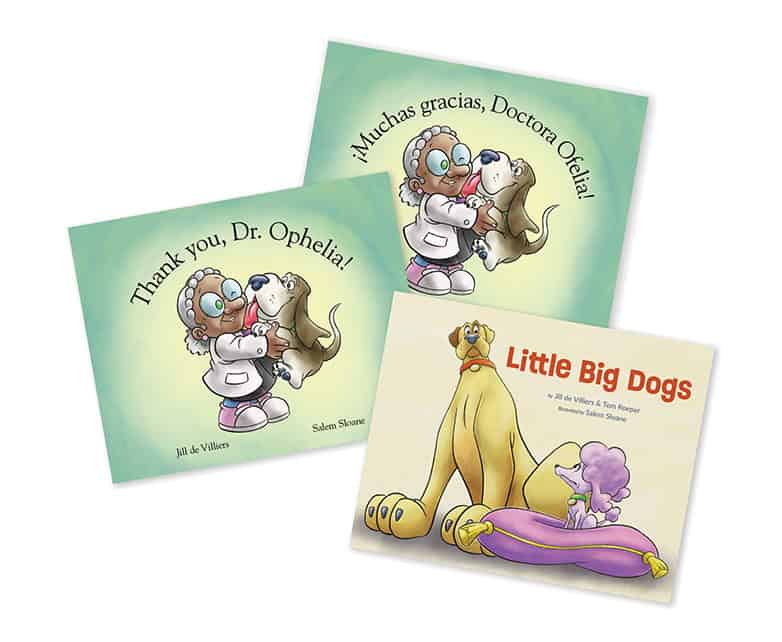
What is the purpose of the book?
This is a note for parents, teachers or language therapists about the book and its contents. The Mind the Book series attempts to present real stories to children with content that is both appealing and educational.
But there is another factor in the design of the books, which is to use examples of complex grammar that the child needs to express the meanings. In “Little Big Dogs” we are introducing a rare form of adjective combination.
Note that in English, adjectives pile up before a noun (unlike languages like French, Romanian). They are usually said in a certain order. We say, “Big brown scary dog” but not “Brown scary big dog”. We seem to know these rules intuitively, as they are not taught.
In such an expression it seems that the dog has three properties: big and brown and scary.
But then a problem arises with “the little big dog”. How can a dog be both little and big at the same time? In fact, the expression means, “the small one in the set of big dogs”.
In this case one adjective is embedded under another, not just added on. This teaches the child an important lesson in grammar and logic.
Questions About the Book by Page Number
Here are some points in the book where you can open discussion with your child.
- Why did Mateo and Zola decide to divide up the dogs by their size?
- How did they decide which dog went in which yard?
- What did the colors of the collar mean?
- Why was it sometimes hard to tell which yard a new dog should go in?
- When the dog escaped, why could they not tell which dog it was?
- When Mateo lined up the dogs by size, what was the problem?
- Why was it better to let the dogs decide which yard to join?
Classroom Activities
Adjectives create sets and subsets, which leads to all kinds of fun. If we have a garden of little flowers, do children understand when we say
“I want only the big little flowers”?
What does it mean if we say:
“I want only the taller short flowers or “the shorter tall flowers”— what is the difference?
- A good classroom activity would be to get children to draw two big circles, and in each circle to draw some things, like big flowers in one and small in the other (or dogs, or houses, or even triangles) Now ask them if the ones they have drawn in each circle are the same size. There should be some variation. If not, they can share their drawings with a classmate’s sets. Can they find the littlest big flower? Which one is the biggest little flower? This helps children realize that adjectives like big and little are relative: they depend on the set. An important lesson is that sometimes, dividing lines are arbitrary.
- Ask children, what other adjectives are like this? Could you imagine a friendly scary dog? How about a cool warm bath? Why can you not have a black white chair?
- Notice also that in the book, the children make the mistake of assuming that all big dogs are alike in their behaviors, as are all little dogs. They soon discover this is not true. This can open discussion about other cases where we might make assumptions, about say, the kinds of things boy versus girls like, or what men and women can do, or what people from different cultures like or do. All of these sets contain variation!
- A challenging one: could the problem that Mateo and Zola faced be solved by having a third yard, for middle-sized dogs? Why, or why not?